Best Temple Management Software in India: Features, Benefits & Selection Guide
Choosing the best Temple Management Software is no longer just a technology
decision it is a decision about how a temple will manage its administration for
years to come. As temples continue to grow, so do the responsibilities that
come with running them. Donations, pooja bookings, financial records,
accommodation, festivals, inventories, volunteers, and devotee services all
demand time, coordination, and accuracy. While many temples still rely on
registers and spreadsheets, these methods often become difficult to manage as
operations expand.
A decade ago, manual administration was sufficient for many religious
institutions because operations were relatively straightforward. Today, the
expectations are very different. Trustees require timely reports, devotees
expect organized services, and large festivals generate an enormous amount of
administrative activity within a short period. The question is no longer
whether temples should adopt technology. The question is whether traditional
administrative methods can continue supporting the growing scale of modern
temple operations.
Choosing the Right Temple Management
Software
Every temple has its own way of functioning, which means there is no single
solution that fits every institution. Smaller temples may only require basic
donation management, while larger temple trusts often need an integrated system
capable of managing accounting, pooja bookings, accommodation, festivals,
inventory, financial reporting, and devotee records from one platform. Choosing
software should therefore be based not only on present-day requirements but
also on how well it can support the temple's future growth.
Many temple trusts begin their search by comparing software based on pricing
or the number of features available. While these factors are important, they
rarely determine whether a solution will continue serving the temple five or
ten years from now. The best Temple Management Software is the one that simplifies
administration without adding complexity, improves transparency, and allows
trustees and administrators to make informed decisions with confidence.
As temples expand, relying on separate systems for donations, accounting,
accommodation, and festival management often leads to duplicate work and
fragmented information. A well-designed Temple ERP brings every department
together into one centralized platform, reducing administrative effort while
ensuring that information remains accurate and easily accessible whenever it is
needed.
The Indian market today offers several temple management solutions, each
designed to address different operational requirements. Some platforms focus
primarily on online bookings or donation management, while others provide broader
ERP capabilities for complete temple administration. The right choice
ultimately depends on the size of the institution, its operational complexity,
and its long-term vision.
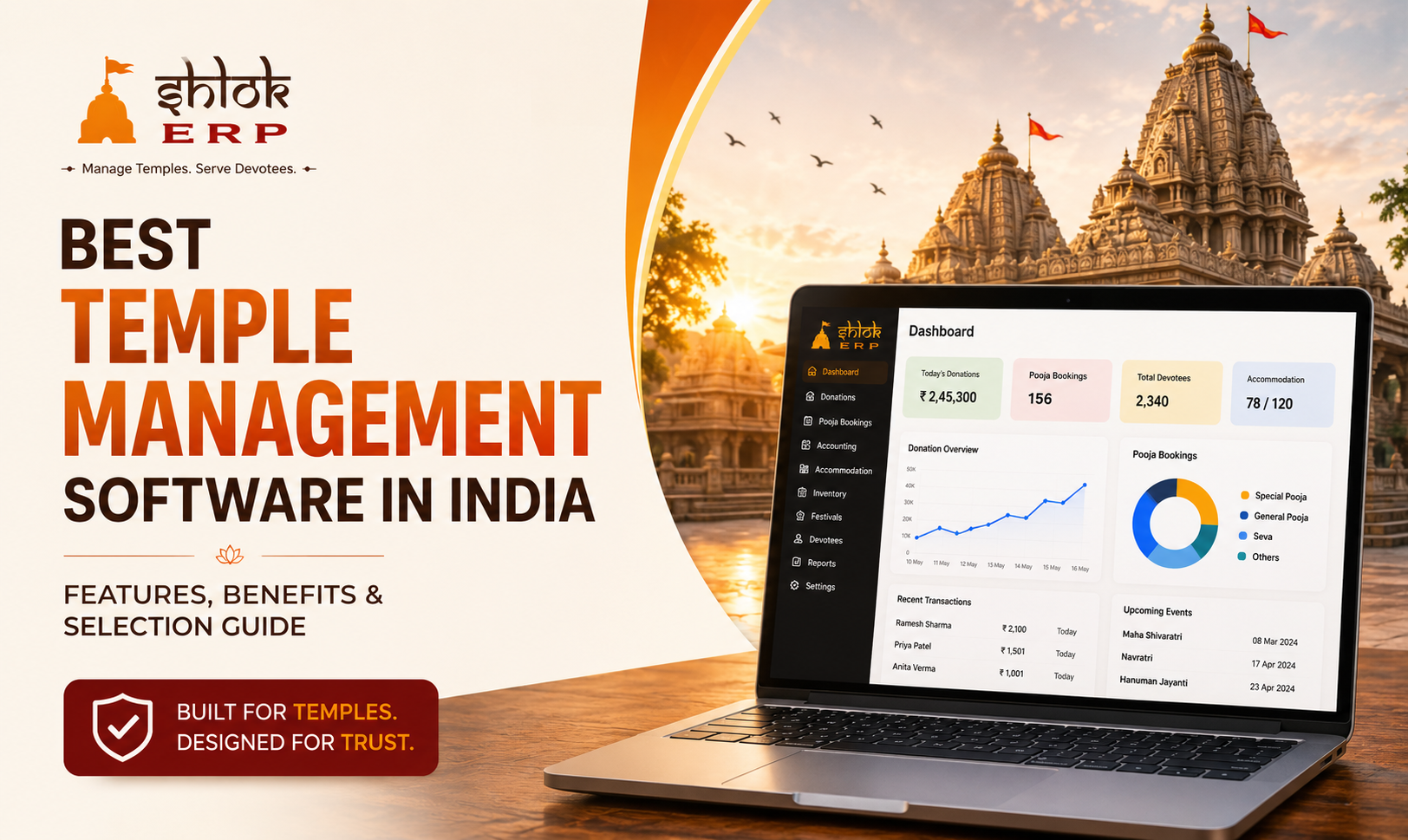
For temple trusts looking for a platform that brings donations, pooja bookings,
accounting, accommodation, inventory, festivals, reporting, and administration
together into one integrated system, Shlok ERP offers a
comprehensive approach designed specifically for modern temple management.
Rather than solving one administrative challenge at a time, it creates a
connected ecosystem that helps temple trusts improve transparency, simplify
operations, and prepare for future growth.
Technology has never been about replacing traditions. Its role is to support the people working behind the scenes so that temples can focus on preserving their spiritual heritage while managing administration more efficiently. As more religious institutions embrace digital transformation, selecting the right Temple ERP becomes less about adopting software and more about building a stronger administrative foundation for the years ahead.