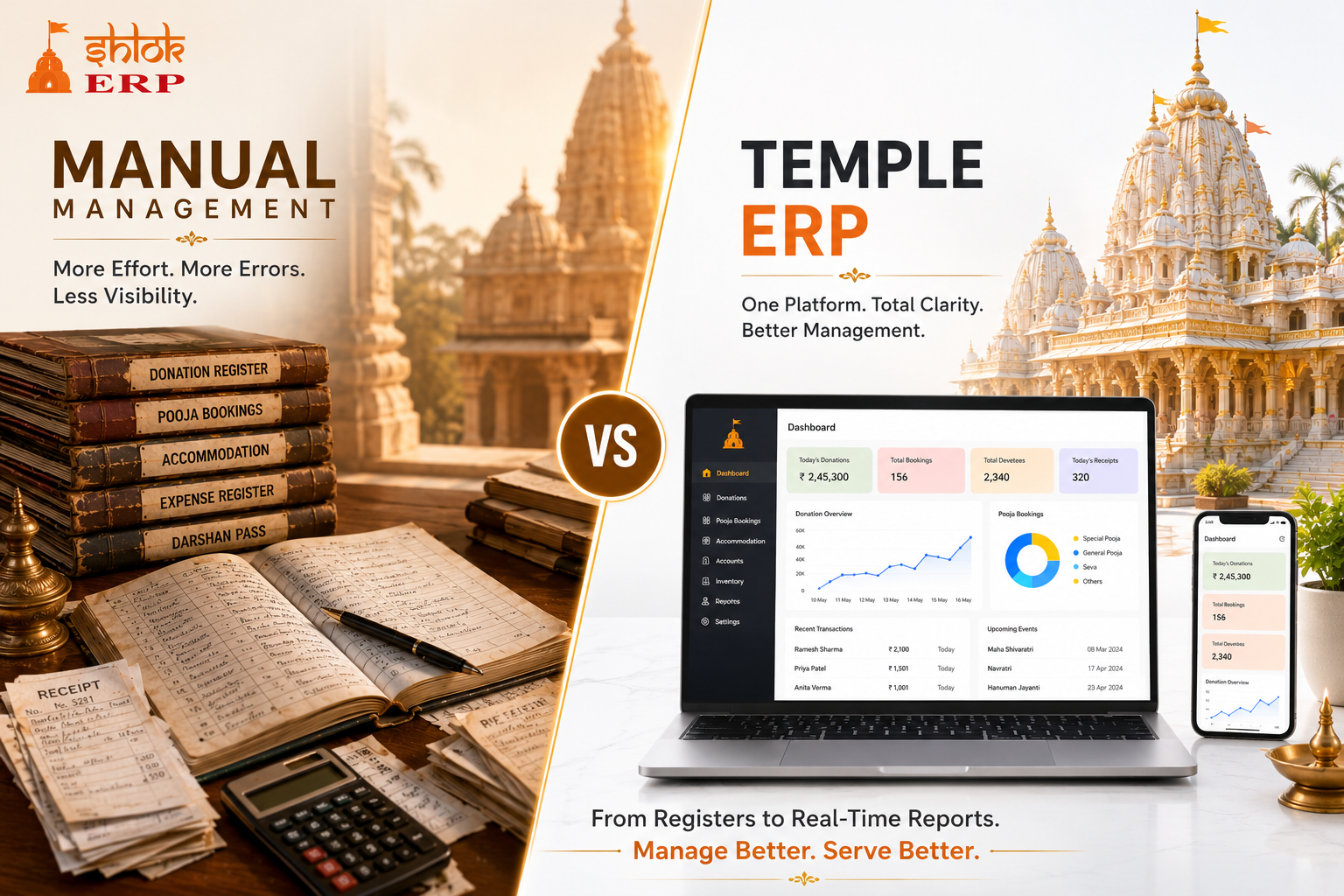
Temple ERP vs Manual Management: Which is Better for Modern Temple Operations?
For decades, temples have relied on registers, handwritten receipts,
spreadsheets, and manual record-keeping to manage their daily activities.
Donations were entered by hand, pooja bookings were maintained in ledgers,
financial reports were prepared manually, and information was often spread
across multiple departments. These methods have served temples faithfully for
generations and continue to be familiar to many administrators.
However, temple administration today is very different from what it was even
ten years ago. A growing temple may welcome thousands of devotees every month
while simultaneously managing donations, accommodation facilities, annadanam
services, festivals, volunteer coordination, inventories, and financial
reporting. As the scale of operations increases, so does the complexity of
managing them efficiently. The challenge is no longer about maintaining records
it is about maintaining them accurately, transparently, and in a way that
supports future growth.
What is a Temple ERP?
Before comparing the two approaches, it is important to understand what a
Temple ERP actually is. A Temple ERP is a centralized software platform
designed specifically for temples and religious institutions. Instead of
maintaining separate registers for donations, accounting, pooja bookings,
accommodation, festivals, devotee records, and administrative activities,
everything is managed through one integrated system.
The purpose of a Temple ERP is not to replace the traditions that temples
have followed for generations. Rather, it simplifies the administration that
supports those traditions. By bringing information together into one platform,
temple administrators can access records quickly, generate reports instantly,
and manage daily operations with far greater visibility than manual systems
allow.
This difference becomes most noticeable during the busiest periods of the
year. Consider a major festival like Navratri or Mahashivratri. Donation
counters remain active throughout the day, special poojas are fully booked,
guest house occupancy increases, volunteers need coordination, and trustees
require regular updates on collections and expenses. With manual processes,
gathering this information usually means checking multiple registers, verifying
entries, and compiling reports from different departments before a complete
picture becomes available.
A Temple ERP changes this experience completely. Donations are recorded in
real time, pooja bookings remain organized, accommodation availability can be
checked instantly, and financial reports are generated whenever required. Tasks
that previously consumed hours of administrative effort can often be completed
within minutes, allowing temple staff to focus less on paperwork and more on
serving devotees.
Why More Temple Trusts Are Moving Towards
ERP
The growing adoption of Temple ERP solutions is not simply the result of
technological advancement. It reflects the changing expectations placed on temple
administration itself. Trustees expect greater transparency in financial
reporting, devotees appreciate faster and more organized services, and
administrators need systems capable of supporting expanding operations without
increasing manual workload.
For smaller temples with limited daily activities, traditional methods may
still work effectively. However, as donations grow, festivals become larger,
accommodation facilities expand, and administrative responsibilities increase,
manual processes often become difficult to sustain. Small delays in reporting,
duplicate entries, misplaced records, or the effort required to retrieve
information may not seem significant individually, but together they create
operational challenges that become more noticeable every year.
A Temple ERP addresses these challenges by creating a single source of truth
for the entire institution. Every department works with the same information,
reporting becomes more accurate, and trustees gain better visibility into
temple operations. Instead of spending valuable time maintaining registers and
preparing reports, temple teams can focus on planning festivals, improving
devotee services, and strengthening the institution's long-term administration.
The conversation today is no longer about choosing technology over
tradition. It is about ensuring that temple administration evolves alongside
the growing responsibilities of modern religious institutions. Technology
quietly supports the work happening behind the scenes so that temples can continue
preserving their traditions while operating with greater efficiency,
accountability, and transparency.
This is why an increasing number of temple trusts are adopting dedicated
Temple ERP solutions such as Shlok ERP not to modernize faith,
but to simplify administration and build a stronger foundation for the future.